



by Ian Angus
Each year the United Nations Environment Program issues an Emissions Gap Report, detailing progress on implementing the 2015 Paris Climate Agreement. The 2025 report was released just before COP30, the global climate change talk fest now underway in Belem, Brazil.
This sounds like good news: “The Paris Agreement has been pivotal in lowering projected global greenhouse gas (GHG) emissions.”
And so does this: “Global warming projections based on current policies have declined from just below 4°C at the time of adoption of the Paris Agreement, to just below 3°C today.”
Read quickly, those sentences seem to show that the Agreement is responsible for reducing the emissions that cause global warming.
But hang on a minute. The sneaky word in those sentences is projections. As the report goes on to show, actual greenhouse emissions in 2024 were higher than ever. In fact, the current rate of growth is more than four times higher than in the 2010s.
So what’s the deal with projections?
Under the Paris Agreement, national governments are supposed to submit Nationally Determined Contributions — their voluntary, non-enforceable plans for reducing emissions by 2035. The first NDCs were submitted in 2020, and the second round, supposedly more ambitious, was due this year, in September. So what the Gap Report reveals are not actual emissions reductions but promises of future reductions.
And even given their imaginary character, the NDCs to date still fall far short of the cuts needed to keep warming below 1.5°C in this century.
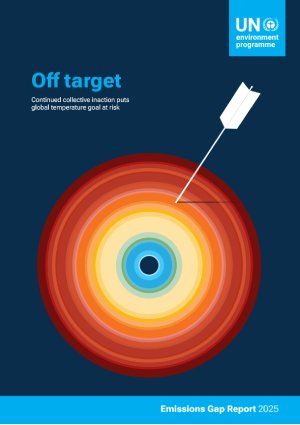
“Despite the new NDCs, the emissions gap in 2030 and 2035 between global GHG emissions resulting from the full implementation of the NDCs and the levels aligned with 2°C and 1.5°C pathways remain large.”
What’s more, of the 195 signatories to the Paris Agreement, only 64 bothered to submit new NDCs by this year’s deadline. And the emission reductions promised by that minority “are relatively small and surrounded by significant uncertainty.”
Add one certainty to that: The United States has pulled out of the Paris Agreement, so its NDCs — a large part of the total promised reductions — will expire in January.
No wonder that UNEP, despite the Pollyanna-ish statements in its first paragraph, titled the whole report Off Target.
As Greta Thunberg said four years ago, before COP26: “Blah blah blah. This is all we hear from our so-called leaders. Words that sound great, but so far have led to no action.”
The influence of oil company lobbyists and petrostates remains dominant at COP30. Be prepared for more blah, blah, blah.
Leave a Comment