


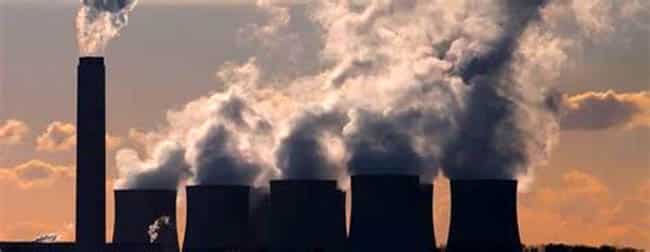
Twice as much fossil fuel as the 1.5ºC goal allows.
That’s the production level now planned by the governments of 20 major greenhouse gas emitters, according to the 2025 Production Gap Report, published this week by the Stockholm Environment Institute, Climate Analytics, and International Institute for Sustainable Development. Official targets for coal, oil and gas production in 2030 total 120% more than the 1.5ºC allows and 77% more than is consistent with a 2.0ºC increase in the global average temperature.
The following are lightly edited excerpts from the report’s Executive Summary.
 Since 2019, the Production Gap Report (PGR) has examined how governments’ collective production plans for coal, oil, and gas diverge from the Paris Agreement’s goal of limiting global warming by “holding the increase in global average temperature to well below 2ºC above pre-industrial levels and pursuing efforts to limit the temperature increase to 1.5ºC above pre-industrial levels.”
Governments have explicitly acknowledged the need to transition away from fossil fuels to achieve this goal, a conclusion now reinforced by an opinion of the International Court of Justice. Yet 10 years on from the Paris Agreement, the situation remains stark: countries are in aggregate planning even more fossil fuel production than before, putting global climate ambitions at increasing risk.
Governments, in aggregate, still plan to produce far more fossil fuels than would be consistent with achieving the goals of the Paris Agreement. Projected 2030 production exceeds levels aligned with limiting warming to 1.5°C by more than 120%.
The production gap is the difference between governments’ planned fossil fuel production and global production levels consistent with limiting global warming to 1.5ºC or 2ºC. This assessment updates the one conducted in the 2023 PGR, which profiled the plans and projections of 20 major fossil-fuel-producing countries, representing a mix of the world’s largest producers.
The resulting analysis finds that governments still plan to produce more than double the amount of fossil fuels in 2030 than would be consistent with the median 1.5ºC pathway. The 2030 gap has increased, to more than 120% above the median 1.5ºC pathway and 77% above the median 2ºC pathway (compared to 110% and 69%, respectively, in the 2023 PGR).
Governments’ fossil fuel production plans also remain well above global levels implied by their stated climate mitigation policies and announced pledges as of September 2024, as modelled by the International Energy Agency.
Taken together, governments now plan even higher levels of coal production to 2035, and gas production to 2050, than they did in 2023. Planned oil production continues to increase to 2050. These plans undermine countries’ Paris Agreement commitments, and go against expectations that under current policies global demand for coal, oil, and gas will peak before 2030.
The near-term gap increase is the result of government plans for expanded coal and gas production. Aggregate planned coal production for 2030 is 7% higher than estimated in the 2023 PGR analysis; planned gas production is 5% higher,
To be consistent with limiting warming to 1.5ºC, global coal, oil, and gas supply and demand must decline rapidly and substantially between now and mid-century. However, the increases estimated under the government plans. and projections pathways would lead to global production levels in 2030 that are 500%, 31%, and 92% higher for coal, oil, and gas, respectively, than the median 1.5ºC-consistent pathway, and 330%, 16%, and 33% higher than the median 2ºC-consistent pathway.
The continued collective failure of governments to curb fossil fuel production and lower global emissions means that future production will need to decline more steeply to compensate. Reaching net zero greenhouse gas emissions in the second half of the century, as the Paris Agreement calls for, will require cutting fossil fuel production and use to the very lowest levels possible.
Every year that countries fail to make progress in curbing fossil fuel production and use, it becomes harder for the world to achieve its climate goals. In the first half of the 2020s, rather than peaking and falling rapidly, fossil fuel production has continued to grow. The time lost has two implications. The first is that cumulative fossil fuel production over the 2020s is likely to be substantially higher than in the 1.5ºCand 2ºC-aligned pathways used to assess the production gap. Thus, even if the world reduces fossil fuel production in 2030 to the levels seen in these pathways, the total coal, oil, and gas extracted over this decade will still be higher than is consistent with these pathways.
Second, these deeper reductions will be harder and more expensive to achieve, as the result of further lock-in of fossil fuel infrastructure added in the 2020s, and the increased pace of reductions required from now on. Even with rapid and concerted efforts starting today, fossil fuel production in 2030 will likely exceed the levels in the 1.5ºC-compatible scenarios presented in this report.
At the same time, the last two years have also shown the importance of keeping the 1.5ºC target in sight. Governments at COP28 agreed to “keep the 1.5ºC goal within reach” and called for countries to submit mitigation targets “aligned with limiting global warming to 1.5ºC.” The 1.5ºC limit has been further reinforced by the International Court of Justice, which found that 1.5ºC is the “primary temperature goal” of the Paris Agreement, and that global and national responses must work towards this goal. Doing so will require reaching net zero greenhouse gas emissions in the second half of this century, as called for in the Paris Agreement. This will require fossil fuel production and use to be cut to the very lowest levels possible.
Analysis in the 2023 PGR indicated that countries should aim for a near total phase-out of coal production and use by 2040 and a combined reduction in oil and gas production and use by three-quarters by 2050 from 2020 levels, at a minimum. Growing evidence supports both the necessity and feasibility of such deep reductions.
Achieving these reductions will require deliberate, coordinated policies to ensure a just transition away from fossil fuels. While a few major fossil-fuel-producing countries have begun to align production plans with national and international climate goals, most still have not.
Cutting fossil fuel production will require deliberate strategies to phase fossil fuel production down and out by the second half of the century. Such strategies would help countries fulfil their Paris Agreement pledges and net zero targets. Chapter 3 of this report summarizes recent developments related to the climate ambitions and the plans, perspectives, and policies for fossil fuel production of 20 major producer countries: Australia, Brazil, Canada, China, Colombia, Germany, India, Indonesia, Kazakhstan, Kuwait, Mexico, Nigeria, Norway, Qatar, the Russian Federation, Saudi Arabia, South Africa, the United Arab Emirates, the United Kingdom, and the United States. Most of these countries continue to plan fossil fuel production at levels inconsistent with their net zero climate ambitions.
17 of the 20 profiled countries still plan to increase production of at least one fossil fuel to 2030; 13 profiled countries plan significant increases in gas production. Moreover, 11 countries now expect higher production of at least one fuel in 2030 than they were planning in 2023, when we last undertook this assessment.
Despite an internationally agreed commitment to phase out “inefficient fossil fuel subsidies” — reiterated as part of the Global Stocktake agreed at the COP28 climate conference — many governments continue to provide substantial direct and indirect financial support for fossil fuels. The countries profiled here support production in multiple ways, including direct investment in infrastructure (Canada), streamlining of contracting procedures (Brazil), direct subsidies or investments for state-owned enterprises (China, India, Mexico), tax incentives for exploration and extraction (Kazakhstan, the Russian Federation), and opening up new areas for exploration and development (US, Norway). The fiscal cost of government support for fossil fuels remains near an all-time high.
As governments submit their third round of nationally determined contributions under the Paris Agreement, they must commit to reversing the continued expansion of global fossil fuel production, explicitly integrate plans for reducing production within wider energy transition efforts, and redouble cooperative efforts to ensure a just transition globally.
Not all the indicators reviewed in this report are negative. Six of the 20 profiled countries are now developing scenarios for domestic fossil fuel production aligned with national and global net zero targets, up from four in 2023. And several governments are actively pursuing clean energy transitions. For example, Colombia has adopted a Just Energy Transition roadmap and announced an investment plan to support it; Germany projects an even faster phase-out of coal production than in prior years; Brazil has launched an Energy Transition Acceleration Program; and China continues to deploy renewables at an unprecedented rate, hitting its 2030 target for solar and wind capacity six years ahead of schedule and lowering carbon dioxide emissions despite growing power demand.
Moreover, multiple countries profiled here remain committed to international cooperation on energy transitions. Although Just Energy Transition Partnerships — launched in 2021 to support a shift away from fossil fuels in emerging and developing countries — have faced implementation challenges, donor countries (except for the US) remain committed to supporting those already underway, and are exploring other types of innovative financing and cooperation mechanisms.
But much more is needed. As this report makes clear, most major fossil-fuel-producing countries have yet to embrace policies for deliberately phasing out fossil fuels and ensuring just transitions (or, in the case of the US, have abandoned them). Widely adopting and implementing such policies will be essential for successfully transitioning to a net zero world at the pace now required.
Continued existence of humanity at its current level of population with the energy demands of modern societies mean that fossil fuels will continue to be used at maximum output, along with maximum use of renewable sources. For example, industrial farming sustains high population density while destroying its own long-term existence through pollution, fossil fuel use etc. There is no alternative system that can feed the global populace while not treating natural resources as infinite.