


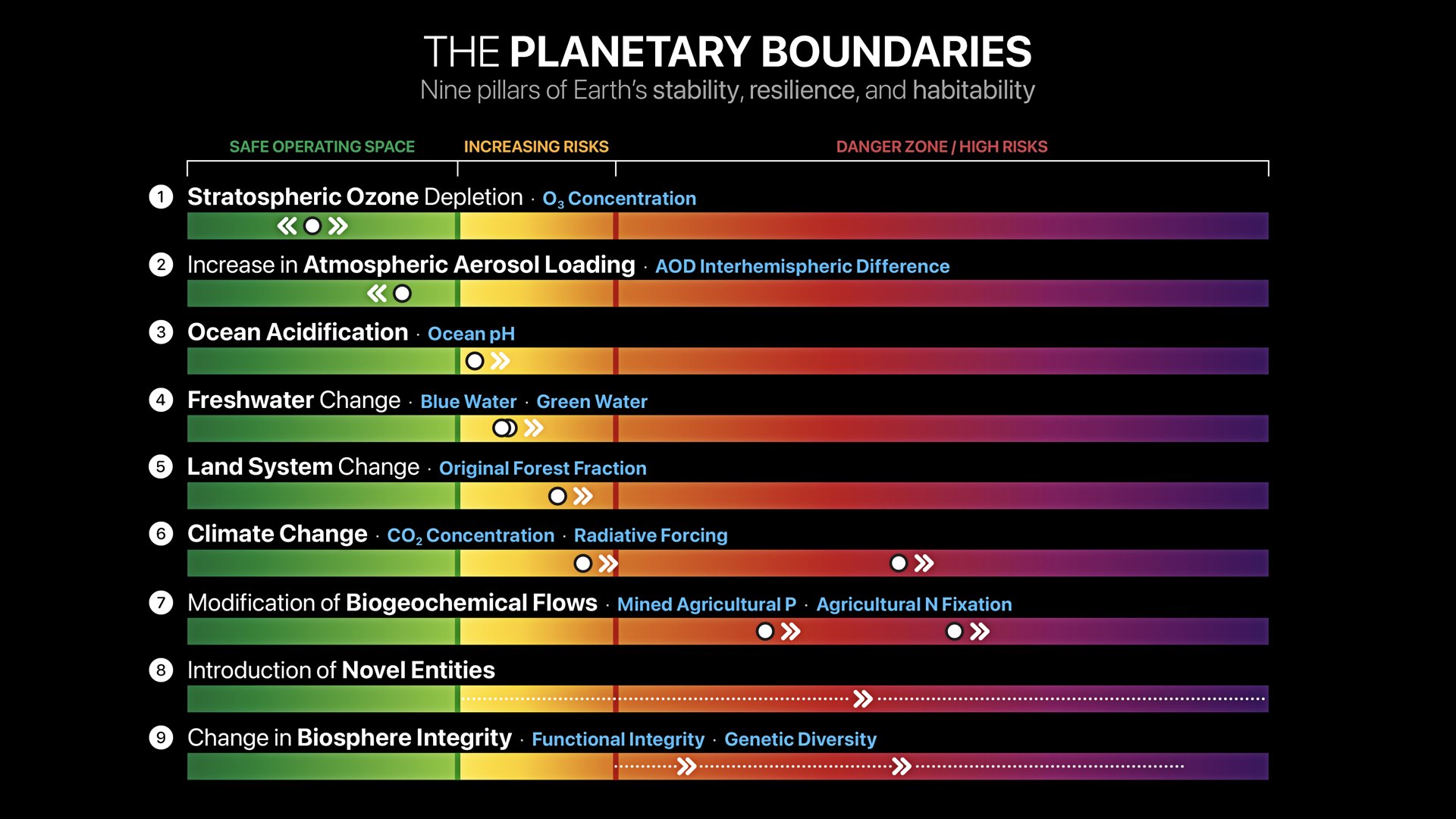
Click for larger image. Seven of nine Planetary Boundaries are transgressed. The colors (green for “within the Safe Operating Space”, yellow for “Zone of Increasing Risk”, and red for “High Risk Zone”) refer to the state of boundary transgression. The boxplot summarizes the 13 control variables used in the assessment. The assessment uses the latest available data, some of which predate 2026. Visual: PBScience
Seven breached Planetary Boundaries continue to worsen as record ocean heat, droughts, floods, wildfires and extreme he at reveal an Earth system under strain, according to the latest Planetary Health Check. The annual update is authored by more than 60 scientists and produced by the Planetary Boundaries Science Lab at the Potsdam Institute for Climate Impact Research (PIK).
The Planetary Boundaries describe the interconnected Earth-system processes that must remain within safe limits to preserve the planet’s stability and resilience. Seven of the nine Planetary Boundaries are now transgressed, with ocean acidification the latest to breach its boundary in 2025. All seven are now at their highest recorded levels of transgression.
The seven transgressed boundaries are: climate change, change in biosphere integrity, land system change, freshwater change, modification of biogeochemical flows, introduction of novel entities, and ocean acidification. Only the stratospheric ozone depletion and atmospheric aerosol loading boundaries have shown improvement over the last decade. However, the authors caution that global progress may mask unsafe aerosol levels persisting in some regions.
“The diagnosis is unambiguous. Pressure is rising across every Planetary Boundary already outside the safe operating space. It means that the risk of large-scale, persistent and potentially irreversible change is increasing, while our margin for error in tackling these problems is shrinking,” commented Boris Sakschewski, lead author of the report.
“We do not have the luxury of time, but we do have the knowledge, capacity and solutions to change course. Accelerating action to return to the safe operating space across all Planetary Boundaries is essential to protect lives and livelihoods, and to deliver on the promise of shared future prosperity,” said Johan Rockström, PIK Director and co-author of the report.
Vegetation and soils absorb a substantial share of human carbon dioxide emissions, but repeated heat, drought, fire and ecosystem degradation can reduce carbon uptake and, in some regions, turn ecosystems from sinks into carbon sources. This year’s report discusses whether the models that we use to calculate the land carbon sink may overestimate its resilience.
“Our path to net zero emissions relies on functioning carbon sinks. Current observations raise the alarm that our planet may be losing its buffering capacity against the increasing pressures we’re putting on it,” Sakschewski said.
A year of extreme events highlights escalating risks
The report comes after 12 months marked by extremes across land and oceans. Human-caused warming intensified several major weather extremes, while degraded ecosystems, water stress, land-use change, exposure and social vulnerability often magnified their impacts.
Pakistan’s 2025 monsoon floods affected more than 6.9 million people. Global ocean heat content reached a new record in 2025, with Hurricane Melissa rapidly ramping up to a Category 5 Hurricane and striking Jamaica after passing over exceptionally warm seas. From January 2023 to September 2025, bleaching-level heat stress impacted about 84.4 percent of the world’s coral reef area, making it the largest global coral-bleaching event observed to date.
In 2026, Western Europe experienced its hottest June-July period on record, accompanied by drought across France, Spain, Germany and the United Kingdom, with major wildfires across Europe and Canada. Record-breaking heat was also recorded in Japan, South Korea and parts of the Middle East.
Hindou Oumarou Ibrahim, Chair of Planetary Guardians, said, “Read that list again: Pakistan, the Caribbean, Europe, the reefs beneath our oceans. These are not separate emergencies; the planet is telling us, in every region at once, that it is out of balance. As Chair of Planetary Guardians, I hear this same story wherever I go, whether from a pastoralist watching the rains fail season after season or a coastal community watching the sea rise. The 2026 Planetary Health Check puts data behind what communities on the frontlines already know from living it. We do not have the luxury of treating these as separate crises any longer.”
(Adapted from material provided by the Potsdam Institute for Climate Impact Research)
It’s a scary report, but it offers nothing that wasn’t known and predicted decades ago. One more report can now be piled on top of an ever growing heap of others saying much the same thing: conditions are bad and rapidly worsening. Most humans know this and most also know why, yet scientists keep waving their arms about programs that have little or no chance of changing anything. They do this because to do otherwise is to be be attacked by governments and politically powerful lobby groups, lose one’s job or fail to be published in prestige journals. Consider, for example, section 6 of this report on Earth’s health, titled ‘Solutions & Outlook’. It offers no solutions and not much of an outlook, except for pointing at the failed Paris Agreements and a few UN programs with good intentions and no teeth. There is no mention of the socio-economic system, capitalism, except to say that the “Doughnut Economics [framework] … can help ensure that future development goals are not only socially ambitious, but also physically achievable on a finite planet”. This is a safe suggestion because it is sufficiently vague to make it completely harmless to the socio-economic system or business as usual.
If you’re wondering how Doughnut Economics (DE) could achieve the wonders mentioned above, the DE website explains that “[Doughnut Economics is] not a set of policies and institutions, but rather a way of thinking to bring about the regenerative and distributive dynamics that this century calls for”. So there you have it: ‘we’ just have to think differently so ‘we’ can apply recommendations, such as “See the big picture” or “Get savvy with systems”. Fantastic! I can now tell family and friends that they don’t need to work two jobs to pay the bills or eat cheap, crappy industrially produced ‘food’ anymore; they just need to think differently and all will be well. Glossy reports, ever more data or ‘systems thinking’ will not change anything materially for people or cut carbon emissions. What could make a difference are things like community organising and union actions that address the underlying social relations that keep capitalism going. Yes, capitalism. The power of capital controls the media, education system, politics, health system, food system, in fact, almost all aspects of our lives. Yet not once is capitalism mentioned in the report or where political and economic power currently lies (spoiler: corporations with only two aims – profits and growth). Political and economic equality will not emerge by getting “savvy with systems” or being “agnostic about growth”, but by dismantling the socio-economic system, the social relations, that continue to destroy our lives and the Earth.