


by Ian Angus
[This is a draft chapter from Social Murder, a book I am writing for Monthly Review Press. Suggestions, comments and corrections are very welcome.]
When Frederick Engels accused England’s rulers of social murder in 1845, his charge had two elements. First, that working people were subject to living conditions that ensured they “inevitably meet a too early and an unnatural death.” And second, that the capitalist class “knows that these thousands of victims must perish, and yet permits these conditions to remain.” He proved his case by citing masses of evidence from official reports and other public documents, showing that the ruling class not only caused the deadly conditions but “knows the consequences of its deeds” so its actions were “not mere manslaughter, but murder.”[1]
Critics of Marxism often claim that capitalism has outgrown the Dickensian harshness and cruelty that Marx and Engels described. Modern capitalists, we’re told, know that such behavior is self defeating, and in consequence are more humane than their Victorian predecessors.
In fact, thanks to access to information laws and disclosures forced by many lawsuits, we now have far more evidence than Engels of capitalists’ depraved indifference, the legal term applied to people who act with extreme recklessness and a total, wicked disregard for human life. Internal documents from some of the world’s largest corporations show their executives covering up evidence of deadly activity, solely to protect their profits. Engels called it social murder and that’s what it is.
Again and again, the supposed humaneness of modern capitalists is overruled by their determination to maintain and expand corporate profits.
As a case in point, consider vinyl chloride, a colorless, sweet-smelling gas made by combining ethylene (made from petroleum) with chlorine (a poisonous gas extracted from seawater), and then converted into polyvinyl chloride (PVC), the second most widely used plastic.
The largest chemical companies knew for years that vinyl chloride was endangering their customers and employees. They studied the evidence, confirmed it privately, and then efficiently concealed it while people contracted painful and ultimately lethal diseases. Thanks to legal action, we have massive documentary evidence that reveals when corporate executives knew that vinyl chloride was dangerous, what they said to each other about it, and how they concealed the scientific evidence.[2]
Mass production of PVC from vinyl chloride began in the late 1940s: Dow Chemical, B.F. Goodrich and Shell were the biggest manufacturers. It was very profitable, but, as the author of The Cancer Factory writes, there were three problems with the gas. “One, it made workers giddy as drunks if they inhaled enough of it while cleaning the reactors in which the gas was cooked under pressure and turned into resin. Two, it was combustible. And three, studies later would find, it could cause cancer.”[3]
After cooking, when the concentration of vinyl chloride had fallen to the supposedly safe level of 500 parts per million, workers known as “pot cleaners” were lowered into the giant tanks to chip remaining residue off the walls. What those workers didn’t know was that as early as 1959, Dow scientists knew that “500 ppm is going to produce rather appreciable injury when inhaled 7 hours a day, five days a week, for an extended period.” Dow shared that finding with B.F. Goodrich, adding “this opinion is not ready for dissemination yet” and should be “held in confidence.”[4]
By the mid-1960s, the industry knew that vinyl chloride was causing workers’ finger bones to dissolve from acro-osteolysis. Goodrich’s internal reports on what they called “the hand disease” were labelled “confidential” and “not to be disseminated.”[5] Company doctors were instructed to examine workers’ hands without explaining why.
In 1972, researchers in European PVC companies found that 250 ppm of vinyl chloride, half the legal level, caused fatal liver cancer in rats. In response, twenty-five American and European producers signed an agreement to keep the findings secret. As historians Gerald Markowitz and David Rosner point out, secrecy agreements to protect intellectual property are not uncommon, but “secrecy, in this case, was not to protect product information, patent secrets, or even innovative experimental procedures. Rather, its sole aim was to avoid a public relations and legal nightmare.”[6]
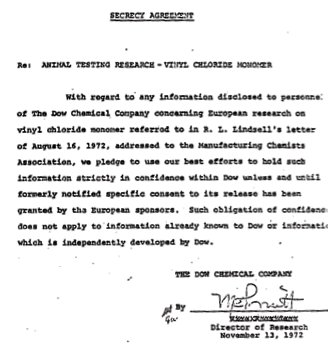
In January 1973, the National Institute for Occupational Safety and Health (NIOSH), the US federal agency charged with proposing standards for workplace safety, issued a mandatory Request for Information on potential hazards of vinyl chloride. When representatives of major chemical companies and their trade association met with NIOSH officials, they continued the coverup. “While appearing to be forthcoming providing information … the industry studiously withheld the key findings of the secret European studies that indicated vinyl chlorides carcinogenic nature.”[7] NIOSH’s director later told the US Senate that “no mention was ever made to us about liver cancer.”[8]
The coverup begin unraveling in January 1974, when a plant physician reported that four workers from a B.F. Goodrich vinyl chloride factory had died of liver angiosarcoma, “a cancer so rare that it accounted for just two dozen deaths in the whole country annually—making four deaths among the several hundred plastics workers akin to an epidemic.” Further study raised the death toll to seven cases between 1963 and 1974, all of them pot cleaners.[9]
OSHA acted quickly when it finally saw the evidence. In May 1974, it proposed a maximum exposure limit of no detectable level, using equipment that could detect one ppm. The industry fought hard to block the change, claiming it would cost $90 billion to implement, drive them out of business and eliminate 2 million jobs. After reviewing 4,000 pages of evidence, the US Appeals Court rejected a Society of the Plastic Industry petition against OSHA’s order, finding that scientific studies showed that there was no safe level for exposure to vinyl chloride. In a scathing statement, Judge Tom Clark said “the record shows what can only be described as a course of continued procrastination on the part of the industry to protect the lives of its employees.”[10] The new standard went into effect in 1975, and none of the industry’s doomsday predictions came true.
Liver angiosarcoma from vinyl chloride exposure takes decades to develop. The most recent summary I’ve found says that 197 deaths had been officially reported by the end of 1998, but the true count is probably much higher, because it is hard to diagnose, and statistics are not tracked in most countries. Exposure limits are not established or enforced in some countries, so the death toll will continue to rise.[11]
The executives of the vinyl chloride industry committed social murders, exactly in the sense that Engels meant—killings committed not with knives or guns but with ledgers, by men who knew that others would die from conditions they controlled, and who let those conditions stand in order protect their profits. Every element of that definition is present in this case. The vinyl chloride executives weren’t stupid or confused or ignorant. They knew what they were doing and why. They hid the facts and continued business as usual, which meant causing sickness and deaths.
Murder requires intent: these deaths were intended to be profitable, and they were. No euphemism, no gentler label, can be accepted.
Addendum: Death by Hairspray
Vinyl chloride gas wasn’t only used to make plastic. In the 1960s and early 1970s, it was used as a propellant for Miss Clairol and other aerosol hairsprays. In 1974, the Environmental Protection Agency found that “a 30 second release of the aerosol could result in a concentration as high as 400 ppm in the air,” and “a detectable concentration of vinyl chloride could still persist for several hours after spraying.”[12] Dow, B.F. Goodrich and others already knew this, and had quietly stopped selling vinyl chloride to aerosol makers, without, of course, telling consumers, barbers and hair stylists that they had been using dangerous amounts of a known carcinogen. Recent research has identified individuals who had worked in salons and barber shops in the 1960s and 1970s and subsequently died of liver angiosarcoma.[13]
[1] Friedrich Engels, The Condition of the Working Class in England (Penguin, 2009 [1845]), 127-8
[2] The most complete account of the vinyl chloride coverup is in chapters 5, 6, and 7 of Gerald Markowitz and David Rosner, Deceit and Denial: The Deadly Politics of Industrial Pollution (University of California Press, 2002).
[3] Jim Morris, The Cancer Factory: Industrial Chemicals, Corporate Deception, and the Hidden Deaths of American Workers, (Beacon Press, 2024) 24-5
[4] Jennifer Beth Sass et al., “Vinyl Chloride: A Case Study of Data Suppression and Misrepresentation,” Environmental Health Perspectives, July 2005
[5] “Dirty Secrets: Vinyl Chloride,” (Environmental Working Group, April 2023)
[6] Markowitz and Rosner, Deceit and Denial, 183.
[7] Gerald Markowitz and David Rosner, “Corporate Responsibility for Toxins,” Annals of the American Academy of Political and Social Science, November 2002:
[8] EWG, “Dirty Secrets.”
[9] Morando Soffritti et al., “Vinyl Chloride: A Saga of Secrecy,” in Late Lessons from Early Warnings: Science, Precaution, Innovation (European Environmental Agency, 2013)
[10] Society of the Plastics Industry, Inc. v. Occupational Safety Health Administration, No. 74-2284 (2d Cir. January 31, 1975).
[11] Janet Kielhorn et al., “Vinyl Chloride: Still a Cause for Concern,” Environmental Health Perspectives, July 2000.
[12] Quoted in Markowitz and Rosner, Deceit and Denial, 208-9.
[13] Peter F. Infante, “Vinyl Chloride Propellant in Hair Spray and Angiosarcoma of the Liver among Hairdressers and Barbers: Case Reports,” International Journal of Occupational and Environmental Health, January-March, 2009.
Leave a Comment