


Bolivia Burning: Inside a Latin American Ecocide
Directed by Tom Johnson. The Gecko Project, 2025. 52 min
reviewed by Ben Radford
Green Left, October 15, 2025
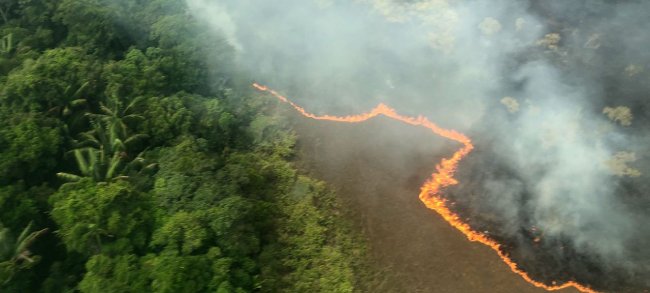
Last year, raging forest fires swept across large parts of South America, burning millions of hectares and claiming hundreds of lives.
Bolivia suffered its worst-ever forest fire season — 12.6 million hectares were burnt, much of it in the tropical dry forests of the eastern lowlands. According to Bolivian NGO Fundación Tierra, nearly 70% of the area burned last year was in the eastern Santa Cruz department, and represents “the worst environmental disaster in Bolivian history.”
While mainstream media fixated on images of flames and destruction — or made vague references to climate change — few examined the drivers of the crisis.
Bolivia Burning: Inside a Latin American Ecocide, a short documentary film released last month, focuses on the worst-affected Santa Cruz department, the heart of Bolivia’s agro-industrial frontier. The documentary focuses on Mennonites — an ultraconservative Christian denomination — who began colonising parts of Bolivia in the 1950s, mostly in the Santa Cruz department. Mennonite colonisation intensified during the past decade, with the number of colonies growing from 75 to 124 in 2013–22 — numbering about 150,000 people.
Mennonite settlements have cleared vast tracts of tropical dryland forest for industrial monocultures, mostly soybean, which they sell on the international commodity market. About 16% of recent deforestation in Bolivia occurred in Mennonite colonies, which also account for a quarter of soybean-related deforestation during the past two decades. Aerial mapping in the documentary shows that just in 2016, Mennonite colonies were responsible for 300,000 hectares of deforestation — roughly the same size as Italy.
Deforestation contributes to worsening forest fires by desertifying previously fire-resistant land. Mennonites and agribusiness interests also deliberately start bushfires as an effective way of expanding the agricultural frontier, and were the cause of last year’s devastation.
In Bolivia Burning, journalists David Hill and Álvaro Bozo García travel through the Santa Cruz region, witnessing the devastation and visiting Mennonite colonies. At one of the colonies, they document recent land clearing of burnt trees following the forest fires, for conversion to monocultures.
Indigenous land
Mennonites are encroaching on Indigenous land, like the Zapocó and Lomerío territories, draining vital water sources for irrigation and displacing local communities through land pressure and buyouts.
The documentary also examines the role of government policy in driving deforestation. Last year, 130 Bolivian organisations directly petitioned then-President Luis Arce, blaming government policies for promoting agribusiness and deforestation. Between 2001–13, state permits for land clearing were capped at 52,000 hectares annually, but by 2018 had risen to more than 250,000 hectares, according to the Bolivian Observatory on Labour Rights and Social Security.
The government adopted and implemented the “Patriotic Agenda 2025” in 2013, which aimed to promote large-scale agriculture expansion as a route to “food sovereignty” and economic growth. The government also weakened environmental protections, such as allowing up to 20 hectares of clearing without a permit or fee and slashing fines for illegal deforestation.
However, the documentary misses some of the historical and economic context of the Santa Cruz region.
Large landowners — part of Bolivia’s mostly white or mestizo oligarchy — own huge swaths of land in Santa Cruz, much of it accumulated during the colonial period and military dictatorships in the last century. This powerful group resisted and undermined the ruling Movement Towards Socialism (MAS) government’s attempted land reforms, with funding and support from the United States.
Despite some important inroads in the Santa Cruz region — such as the return of businessman Branko Marinković’s land to Indigenous communities — land reform could not be implemented as successfully as in other regions.
However, Bolivia made important advancements, such as introducing the world’s first law granting specific legal rights to nature in 2010 and reducing the deforestation rate by 64% between 2010–13. While the MAS’s weakening of its previously strong environmental protections deserved criticism, a strategy of the right-wing elite was to co-opt legitimate ecological concern to disguise their regime-change agenda.
Corporate complicity
Bolivia Burning highlights the role of US-based agribusiness giant Cargill as one of Bolivia’s biggest buyers of soy, most of it sourced from destructive Mennonite monocultures. This is despite the company pledging in 2014 to eliminate “deforestation from the production of agricultural commodities such as palm oil, soy, paper and beef products by no later than 2020”.
Cargill, the US’ biggest privately owned company that has cornered much of the global food market, expands and profits from what some interviewed in the documentary call an “ecocide economy” — a system where cheap animal feed and corporate profit margins are predicated on ecological devastation.
While not mentioned in the documentary, corporate financiers — such as BNP Paribas, Barclays, Santander and Bank of America — have provided many billions of dollars worth of loans and financial services to Cargill since 2021.
In Bolivia Burning, Indigenous community members give emotional testimonies of watching their ancestral forests be destroyed by deforestation and fires. Their accounts frame the fires not as a natural catastrophe but as a continuation of colonial dispossession, driven by agribusiness.
This is a strange article with its focus on an albeit generally reactionary religious minority, who, judging from the data presented, seem to be only responsible for a small proportion of the devastation taking place in Bolivia’s forests.
The article says that 12.6 milion hectares were cleared in 2024, but does not say how much of that was done by Menonnites, only that some of them cleared 300,000 hectares in 2016. Even if that had doubled by 2024, it would still be only 5% of the total. And that 300,000 hectares is not an area the size of Italy as is claimed here: it is 1% of that country’s 300,000 sq km.
I’m not convinced it is good politics to focus on this group as members of a religious minority. Do none of them, or people of Mennonite origin, object to these agricultural practices?